Research Chemicals
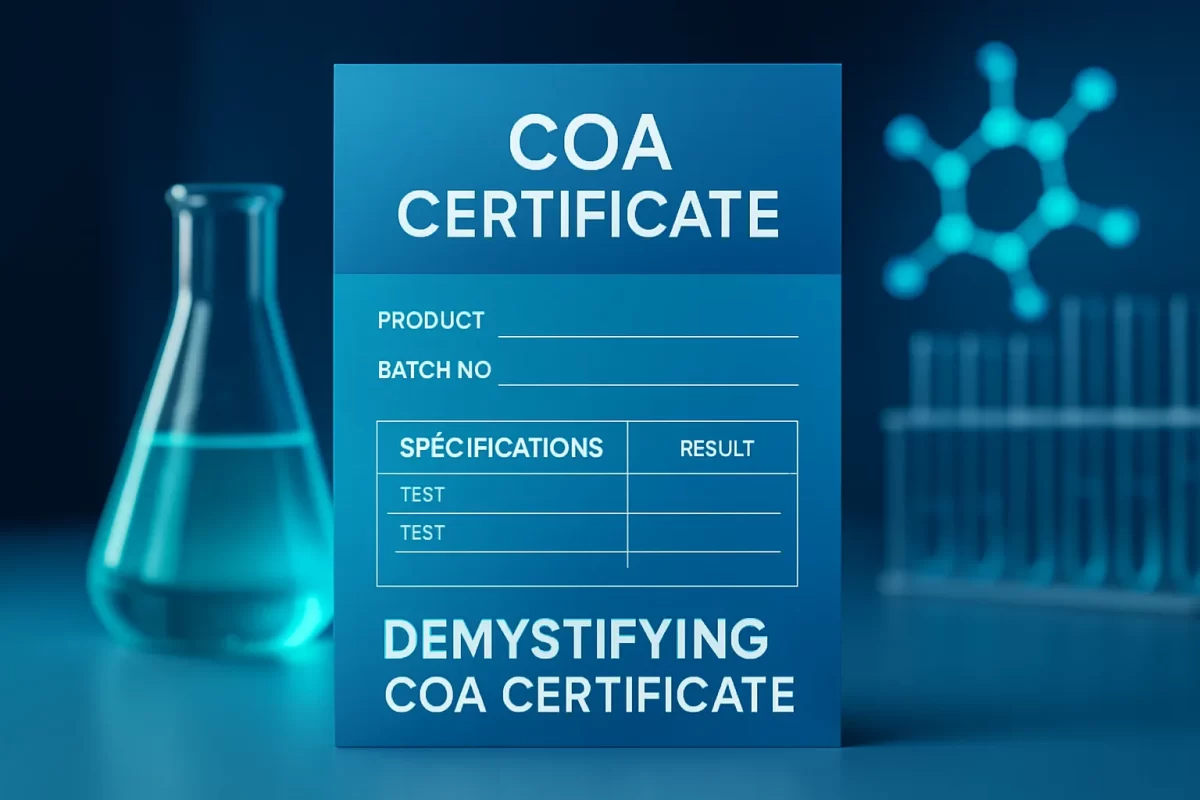
Demystifying the COA Certificate: A No-Nonsense Guide
Feb
Ever unpacked a shipment from RocazoneMix and stared at that COA, wondering what the numbers really mean? You’re not alone. I’ve lost count of the times I’ve compared vendor COAs side by side to nail down a method or chase down an unexpected impurity. COAs can make or break your next experiment.
In this guide, I’ll walk you through the nuts and bolts of COA certificates: what they are, who needs them, and how to get the most out of them. We’ll dive into terminology (COA vs. CoC), decode every section of a COA, and show you best practices for requesting, interpreting, and storing these critical documents. Plus, you’ll see how RocazoneMix’s digital portal and rigorous QC process give you audit-ready COAs without the legwork.
By the end, you’ll have a clear COA playbook—one that helps you avoid costly delays, maintain compliance, and ensure the integrity of your research materials from order to analysis.
Case in point: last summer, a minor impurity spike of 0.3% in one batch threw off an entire calibration curve. That 0.3% difference cost me a week of troubleshooting—and caused a minor cringe in front of my PI. If only I’d double-checked the COA details earlier.
So let’s demystify the COA certificate together, and give you the confidence to order, analyze, and store your chemicals like a pro.
What Is a COA Certificate?
At its core, a Certificate of Analysis (COA) is a batch-specific report detailing the analytical test results for a sample. It’s not a marketing brochure or a generic compliance statement—it’s a data-driven document generated by an accredited lab or QC department, showing you exactly what’s inside each vial or bottle. For a deeper dive into the standardized definition, see the Certificate of Analysis wiki entry.
Contrast that with a Certificate of Conformity (CoC), which is often a supplier’s declaration that an item meets certain specs without listing actual measured values. You might see a CoC stating “complies with spec,” but without method names, lot numbers, or numeric results, there’s no way to verify. That’s like buying coffee and trusting it’s “medium roast” without seeing a roast profile.
Key elements that make a COA essential:
- Batch Traceability: COAs tie results to precise lot numbers and production dates, so you can trace back to the original sample if anything goes sideways.
- Method Transparency: Every test lists the analytical method—HPLC, GC, ICP-MS, Karl Fischer—often with pharmacopeial references (USP, EP) or validated in-house protocols.
- Quantitative Data: You get actual values (e.g., 98.6% purity, 5.2% moisture, <0.5 ppm heavy metals) alongside acceptance criteria.
- Accreditation & Signatures: ISO/IEC 17025 marks, GMP compliance requirements, and authorized QA/QC sign-offs ensure data integrity and audit readiness.
To explore the importance and key components in more detail, check out this guide to COA importance and components.
Who Relies on COA Certificates (and Why)
In my two decades of lab experience, I’ve seen COAs prove their worth across diverse fields. Here’s a closer look at who depends on these documents—and why missing or flawed data can be a deal-breaker.
- Pharmaceutical R&D & APIs:
Regulated by FDA cGMP and ICH Q7, pharma teams need verified potency and impurity profiles for active pharmaceutical ingredients (APIs) and intermediates. Even a 0.1% deviation in assay results can trigger batch rejections or stall clinical timelines.
- Food & Beverage Safety:
Testing for allergens, microbial limits, and contaminants like pesticides or heavy metals is mandatory in food production. A COA with missing methods or no numeric limits can result in import holds or costly recalls—think Listeria or heavy-metal alarms.
- Chemicals & Raw Materials Manufacturing:
Whether you’re making polymers, coatings, or specialty chemicals, downstream performance hinges on input purity and physical properties. An unverified lot may throw off reaction kinetics or product stability.
- Academia & Analytical Reference Labs:
Method development and instrument validation rely on high-quality reference standards. Inconsistent COA data can compromise calibration curves and invalidate your entire dataset.
- Cosmetics, Cannabis/Hemp & Environmental Labs:
Ingredient safety tests, potency measurements, and environmental contaminant screens demand precise, transparent results. Regulatory agencies and consumers alike expect rigorous documentation—especially when testing cannabinoids in a sample like Apaan Oil.
Imagine you’re a formulation scientist preparing a new API batch. Without a clear COA, you risk scaling up impure intermediates, skewing bioavailability studies, or failing audits. The bottom line: COAs are your primary defense against compliance headaches and research setbacks.
Anatomy of a COA: Breaking Down Every Field
COAs may look like dense spreadsheets, but each section serves a critical purpose. Let’s decode a typical COA, field by field:
1. Product & Traceability Information
- Product Name & Code: Exact chemical name and catalog or SKU code (e.g., 3CMC).
- CAS Number & Molecular Formula: Unambiguous identifiers that tie back to chemical registries.
- Lot/Batch Number: Unique code (e.g., RZMX-2023-001) used for trace-back.
- Manufacture & Expiry Dates: Dates of synthesis, packaging, and recommended retest or expiry.
2. Test Methods & Specifications
- Method References: USP chapters (e.g., USP 621), EP monographs, or in-house validated SOPs.
- Analytical Techniques: HPLC, GC, GC-MS, ICP-MS, UV-Vis, Karl Fischer, microbiology assays.
- Acceptance Criteria: Numerical ranges (e.g., ≥98.0% purity, ≤0.2% moisture).
- LOD/LOQ Thresholds: Limits of detection/quantitation, essential for interpreting “<LOD” flags.
3. Numeric Results vs. Pass/Fail Flags
Results are reported as precise values with units. For example, “99.3%” or “<1 ppm.” Pass/Fail notations accompany any results that fall outside numeric specs, but best practice is always to report the numeric value where possible.
4. Accreditation & Signatures
- Laboratory Accreditation: ISO/IEC 17025 logo, GMP compliance requirements.
- Analyst & Reviewer Signatures: Names, dates, and roles of each signatory.
- Contact Information: Laboratory address, phone, and email for queries or complaints.
Here’s a simplified view of how these elements come together:
| Section | Example Field | Content |
|---|---|---|
| Traceability | Lot Number | RZMX-2023-001 |
| Specifications | Purity | ≥ 98.0% |
| Results | Purity Result | 99.2% |
| Method | Assay Method | HPLC (USP 621) |
| Signatures | QA Approval | Jane Doe, 2025-01-15 |
This level of detail empowers you to validate the COA internally, cross-reference methods against SOPs, and quickly escalate any questions back to your supplier.
How RocazoneMix Ensures COA Integrity
Not all suppliers offer the same level of COA transparency. Here’s our approach to ensuring you get bulletproof certificates every time:
- Multi-Layered Quality Checks: Our in-house QC team conducts initial tests for assay, moisture, and contaminants. Then we send a representative sample to a third-party ISO/IEC 17025-accredited lab for confirmation.
- Secure Digital Portal: The moment QA approves your COA, it’s published to our encrypted customer portal. No more hunting through emails or waiting for PDFs—just log in and download.
- Rigorous Data Standards: We maintain a 99% pass rate at ≥98% purity for all non-proprietary compounds. Heavy metals, residual solvents, and microbial analyses consistently land well below specification limits.
- Audit-Grade Documentation: Every COA includes digital signatures, ISO accreditation badges, version history, and a full audit trail. That means you can paint a clear compliance narrative for regulators or accreditors.
By combining in-house expertise with independent validation, we remove guesswork from your supply chain. You get a single source of truth for your chemical identity and purity—critical for reproducible results and regulatory submissions.
Generating and Requesting Your COA
5.1 Behind the Scenes: How Labs Issue a COA
Most labs follow a structured workflow to generate a COA. Here’s a typical sequence:
- Batch Identification & Sampling Plan: After synthesis or production, a predetermined sampling plan selects vials from the beginning, middle, and end of the lot to ensure representative testing. For example, batch numbers like RZMX-2023-001 for Etonitazene are documented in your LIMS.
- Validated Testing Procedures: Each parameter—purity assay, moisture content, heavy-metal screening, microbial limits—is analyzed using calibrated instruments. Methods are validated per USP, EP, or internal SOP guidelines, with instrument qualification logs linked.
- Data Recording & QA/QC Review: Raw data (chromatograms, spectra, instrument logs) are captured digitally. A QC analyst reviews the numbers, flags any out-of-spec results, and initiates investigations if needed. QA personnel provide the final sign-off.
- Document Assembly & Digital Publication: A master template auto-populates fields from the LIMS. Electronic signatures lock each section, after which the COA is published to customer portals and emailed as a secure PDF.
5.2 How You Can Request Yours
At RocazoneMix, we make COA access frictionless:
- Pre-Shipment Auto-Delivery: Every order automatically includes the latest COA, downloadable from your order confirmation page.
- Ad-Hoc Requests: Need COAs for past orders? Simply email support@rocazonemix.com with the batch number, CAS, and order ID. You’ll receive your COA within one business hour.
- Portal Self-Service: Use our portal to search by CAS number, batch, or date and retrieve COAs in PDF or CSV formats.
- Third-Party Testing Coordination: If you want an independent COA, let us know your scope—method details, raw data sets, or full chromatograms—and we’ll facilitate accredited lab testing under confidentiality agreements.
Tip: Always include the lot number exactly as shown on the container label to avoid delays. And specify if you need ISO accreditation details or raw data attachments.
Spotting Red Flags & Interpreting COA Data
Even with a solid COA structure, mistakes happen. Here’s how to spot issues before they impact your research:
- Missing or Ambiguous Units: Results must include clear units (%, ppm, µg/g). A value like “1.76” without context is meaningless.
- Pass/Fail Only: If a COA just shows “Pass” or “Fail” without numeric data, you lose insight into how close the sample is to spec limits.
- Vague Methods: Methods should reference a pharmacopeial chapter or validated SOP. “GC” alone won’t cut it.
- Inconsistent Batch Trends: Plot COA data over time. A sudden jump in moisture content or impurity levels often signals a process change or sampling error.
- No Accreditation References: Ensure ISO/IEC 17025 or GMP credentials are visible. Lack of accreditation undermines confidence.
- Footnotes & Disclaimers: Watch for asterisks or footnotes that push testing to “raw material” or “supplier qualification” only. That means your finished lot might not have been tested.
Use COAs as a proactive tool, not just a compliance checkbox. If you detect anomalies—say, a heavy-metal result reported as “<LOD” with no LOD value in a high-risk sample like Crystal Meth—ask for raw data or a retest immediately. It’s far cheaper to catch issues early than to rerun a full experiment.
Best Practices for Storing & Managing COAs
When you handle dozens or hundreds of COAs, a robust management system is essential. Here are best practices to keep everything audit-ready:
- Centralize in LIMS or WMS: Integrate COA storage with your inventory system. Link each COA file to its corresponding batch number and container barcode for instant retrieval. For advanced COA management in LIMS, see this overview of key features and benefits.
- Implement Version Control: Use a document management system (DMS) that tracks edits, approvals, and archival. Maintain an immutable audit trail to show who accessed or modified each COA.
- Digitize & Integrate: Convert any paper COAs into searchable PDFs using OCR. Sync COA metadata—such as expiry dates and test parameters—with your inventory dashboard for FIFO (first-in, first-out) rotation and expiry alerts.
- Automate Notifications: Configure your system to flag upcoming retest dates or missing COAs for new arrivals. Automated dashboards can highlight compliance gaps before audits.
- Align with GMP/GLP & ICH Q7: Ensure your COA management workflows meet regulatory requirements. Regularly audit your process against ICH Q7 and FDA guidelines to avoid citations during inspections.
By treating COAs as living documents rather than static PDFs, you maintain traceability, reduce errors, and keep your lab running smoothly under any audit.
Ready-to-Use COA Template & Checklist
To get you started, here’s a customizable COA template. You can copy, paste, and adapt it in your LIMS or preferred document editor:
| Field | Format / Example |
|---|---|
| Product Name | Plain text (e.g., “4-Aminobenzoic Acid”) |
| CAS Number | Numerical (e.g., 150-13-0) |
| Batch/Lot Number | Alphanumeric (e.g., RZMX-2024-089) |
| Date of Analysis | YYYY-MM-DD |
| Test Parameters | List (Purity, Moisture, Heavy Metals, Microbial Limits) |
| Methods | Text with references (e.g., “HPLC—USP 621”) |
| Specifications | Numeric ranges (e.g., Purity ≥ 98.0%) |
| Results | Numeric (e.g., 99.3%) |
| Pass/Fail | Pass, Fail |
| Analyst | Name & Signature |
| QA Approval | Name, Role & Date |
You can also tailor this template for specific products like 4CMC by adjusting the fields to match your product’s specifications.
5 Things to Verify Before Using a Chemical
- Verify product and CAS number match your order.
- Check that all results include numeric values with clear units.
- Confirm test methods reference reputable standards (USP, EP) or validated SOPs.
- Ensure the document carries an ISO/IEC 17025 accreditation mark and QA signature.
- Review the document date and version history for currency.
For non-pharma sectors, simply add rows for microbiological tests (E. coli, Salmonella), allergen screens, or extractables/leachables based on your regulatory context.
This template and checklist help you standardize COA reviews and streamline supplier communications. Paste this into your LIMS, apply your branding, and you’re ready to roll.
Conclusion & Next Steps
We’ve covered the full COA journey—from understanding what a COA is, to requesting, interpreting, and storing these vital documents. With this playbook, you can avoid compliance pitfalls, optimize your analytical workflows, and maintain a clear audit trail.
At RocazoneMix, we back every order with multi-layered QC and instant digital COAs so you can focus on science, not paperwork.
Download our COA certificate template and browse RocazoneMix’s catalog of high-purity research chemicals. Every order ships with an audit-ready COA—guaranteed.
All RocazoneMix products are sold strictly for research or analytical use only. Not for human or animal consumption.

