Research Chemicals
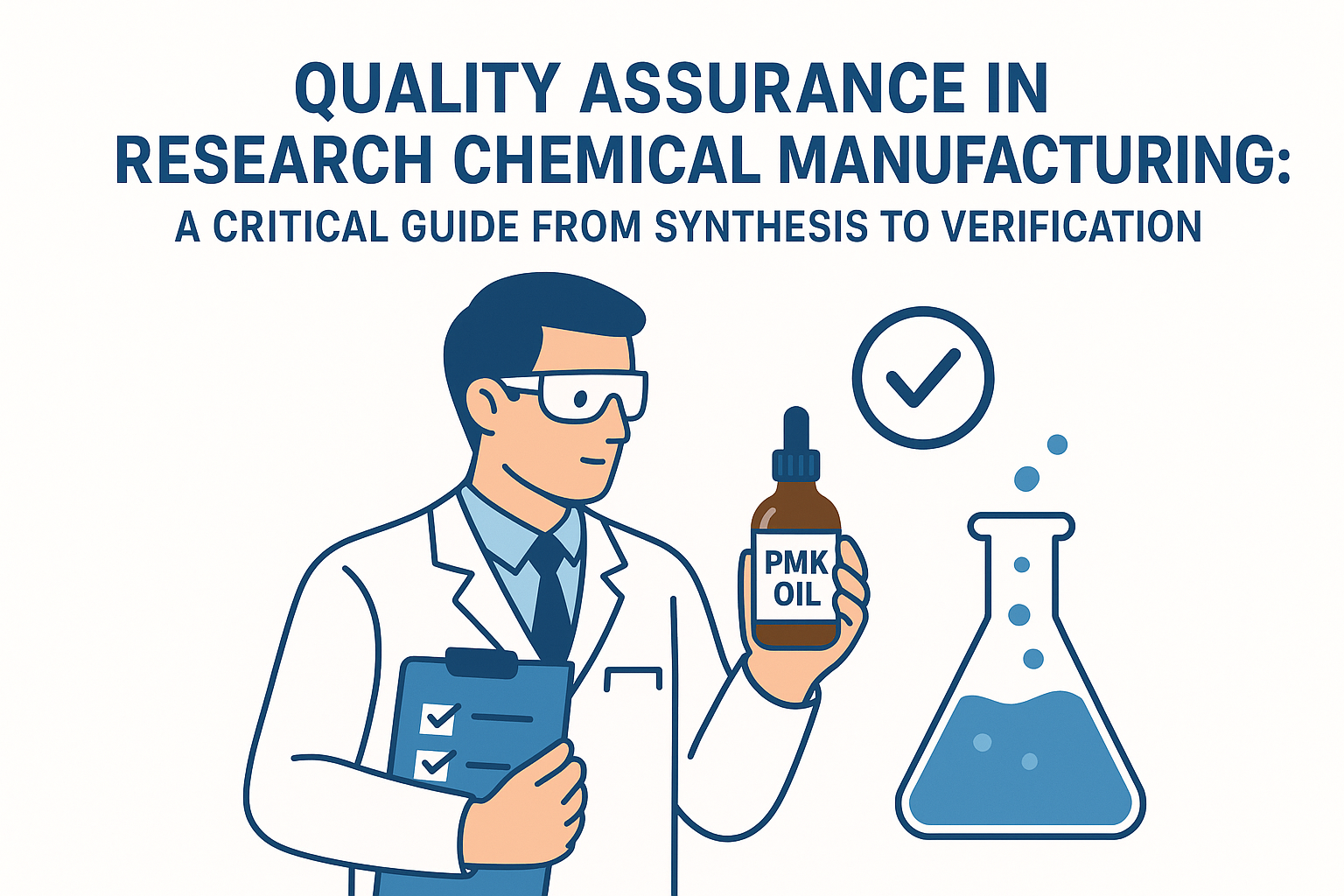
Quality Assurance in Research Chemical Manufacturing: A Critical Guide from Synthesis to Verification
Oct
Introduction: Why Quality Assurance is the Bedrock of Reliable Research
In the fast-paced world of scientific discovery, research chemicals are the essential building blocks for breakthroughs in medicine, materials science, and beyond. However, the integrity of any research outcome is directly dependent on the quality of the chemicals used. A single impurity or misidentified compound can lead to months of wasted effort, invalidated data, and flawed conclusions.
This is where a rigorous Quality Assurance (QA) system becomes not just a best practice, but an absolute necessity. It’s a comprehensive framework that oversees every single step of the manufacturing process, ensuring that every batch of a research chemical meets stringent specifications for identity, purity, and composition.
In this article, we’ll take a deep dive into the critical pathway of QA in research chemical manufacturing, tracing the journey from initial synthesis all the way to final verification and documentation.
What is Quality Assurance in this Context?
Before we delve into the stages, let’s define our terms. In research chemical manufacturing, Quality Assurance (QA) is the overarching system of processes and procedures designed to ensure a product consistently meets predefined quality standards. It is a proactive and preventative approach.
It’s important to distinguish this from Quality Control (QC), which is a subset of QA. QC is the reactive part of the process—the specific set of tests and analyses performed on the final product to verify its quality. QA is the plan, while QC is the execution of that plan.
A robust QA system is built on several key pillars:
- Standardized Procedures (SOPs): Documented methods for every operation.
- Traceability: Complete batch records from raw materials to finished product.
- Personnel Training: Qualified staff who understand and follow protocols.
- Equipment Calibration: Regularly maintained and calibrated analytical instruments.
The QA Lifecycle: From Synthesis to Verification
The journey of a research chemical through a quality-centric manufacturing process involves several distinct but interconnected stages.
Stage 1: The Foundation – Sourcing & Synthesis under Controlled Conditions
Quality begins at the very origin. The synthesis process itself must be conducted under strictly controlled conditions.
- High-Purity Starting Materials: The quality of the final product is contingent on the quality of the raw materials. All starting reagents and solvents must be sourced from reputable suppliers and their certificates of analysis (CoA) verified.
- Standardized Synthesis Protocols: The chemical synthesis must follow a well-documented, validated, and reproducible method. Any deviation from the established procedure must be thoroughly documented and justified.
- Controlled Environment: Synthesis should occur in a clean, controlled laboratory environment to prevent contamination from external sources.
Stage 2: The First Check – In-Process Quality Control (IPQC)
QA is not just about testing the final product. In-Process Quality Control involves monitoring the synthesis while it is happening. This allows for the early detection of issues, saving time and resources.
- Reaction Monitoring: Using techniques like Thin-Layer Chromatography (TLC) to track the progress of a reaction and confirm the consumption of starting materials.
- Intermediate Testing: Isolating and analysing key intermediates to ensure they meet expected purity and structural benchmarks before proceeding to the next synthetic step.
Stage 3: The Purification Imperative
After synthesis, the crude product almost always contains impurities, by-products, and unreacted starting materials. Purification is a critical step where QA principles are vital.
- Choosing the Right Method: The selection of purification technique—whether it’s recrystallization, distillation, or chromatography—must be justified and documented based on the chemical’s properties.
- Validating Purity Post-Purification: A quick analytical check (e.g., TLC or melting point) is often performed immediately after purification to confirm its success before moving to formal QC analysis.
Stage 4: The Cornerstone of QA – Analytical Verification & Quality Control
This is the heart of the QC process, where the purified compound is subjected to a battery of analytical tests to provide irrefutable proof of its identity and purity.
- Identity Confirmation (What is it?):
- Mass Spectrometry (MS): Determines the molecular weight and fragments the molecule, providing a unique “fingerprint” that confirms the molecular structure.
- Nuclear Magnetic Resonance (NMR) Spectroscopy: (Especially 1H NMR and 13C NMR) is the gold standard for confirming the chemical structure and atomic connectivity within the molecule.
- Fourier-Transform Infrared (FTIR) Spectroscopy: Identifies functional groups present in the molecule.
- Purity Assessment (How pure is it?):
- High-Performance Liquid Chromatography (HPLC) or Gas Chromatography (GC): These are the primary techniques for quantifying purity. They separate the components of a sample, allowing for the precise quantification of the main compound and the identification and measurement of any impurities. A purity of ≥98% is often a standard benchmark.
- Elemental Analysis (EA): Determines the percentages of carbon, hydrogen, nitrogen, and other elements in the compound, providing complementary data to confirm both identity and purity.
Stage 5: The Final Seal – Documentation & Certification
The analytical data is meaningless without proper documentation. This stage closes the QA loop and provides the customer with confidence.
- Certificate of Analysis (CoA): This is the most important document for the end-user. A comprehensive CoA should include:
- Compound Name and CAS Number (if applicable)
- Batch/Lot Number
- Date of Manufacture and Expiry
- Purity Percentage (as determined by HPLC/GC)
- Physical Description (e.g., white crystalline powder)
- A summary of key analytical data (e.g., NMR chemical shifts, HPLC chromatograms)
- Storage Recommendations
- Batch Records: The complete manufacturing and testing history for each batch must be meticulously archived, ensuring full traceability.
Why Partnering with a QA-Focused Manufacturer is Crucial for Your Research
Choosing a supplier with a transparent and rigorous QA system is one of the most critical decisions a researcher can make.
- Data Integrity & Reproducibility: High-quality, well-characterized chemicals are the foundation of reproducible science.
- Safety: Accurate identification and purity ensure you are working with the compound you expect, mitigating safety risks.
- Efficiency: Saves valuable time and resources by eliminating the need to troubleshoot experiments compromised by impure or misidentified chemicals.
- Regulatory Compliance: For research that may lead to publications or regulatory submissions, having detailed CoAs from your supplier is essential.
Conclusion: Quality Assurance is Not an Option, It’s a Prerequisite
In the realm of research chemical manufacturing, Quality Assurance is the thread that ties scientific integrity to reliable outcomes. It’s a holistic system that demands diligence at every stage—from the first gram of a starting material to the final signature on a Certificate of Analysis.
By understanding this process and insisting on suppliers who can demonstrate this level of commitment, researchers can be confident that the chemicals they use will support, not sabotage, their pioneering work. In science, quality isn’t everything; it’s the only thing that ensures progress is real and reliable.
FAQ Section
Q1: What is the difference between a “research chemical” and a standard laboratory reagent?
A: While both require quality, “research chemicals” are often novel, less-common compounds used in early-stage research. They may not have established pharmacopoeia standards, making the manufacturer’s in-house QA/QC even more critical for guaranteeing their identity and purity.
Q2: What does ≥98% purity by HPLC mean?
A: This indicates that when analysed using High-Performance Liquid Chromatography, the main compound accounts for at least 98% of the total material detected. The remaining ≤2% consists of identifiable and unidentified impurities.
Q3: Why is NMR data important if I’m not a spectroscopist?
A: Even if you don’t interpret the data yourself, the presence of an NMR spectrum on the CoA is a strong indicator that the manufacturer has taken the necessary step to confirm the compound’s fundamental structure. It provides a level of verification that simpler tests cannot.
Q4: How should I store my research chemicals upon receipt?
A: Always follow the storage recommendations on the Certificate of Analysis. Typically, this means storing in a cool, dry place, often in a desiccator and protected from light, to maintain stability and purity over time.

