Research Chemicals
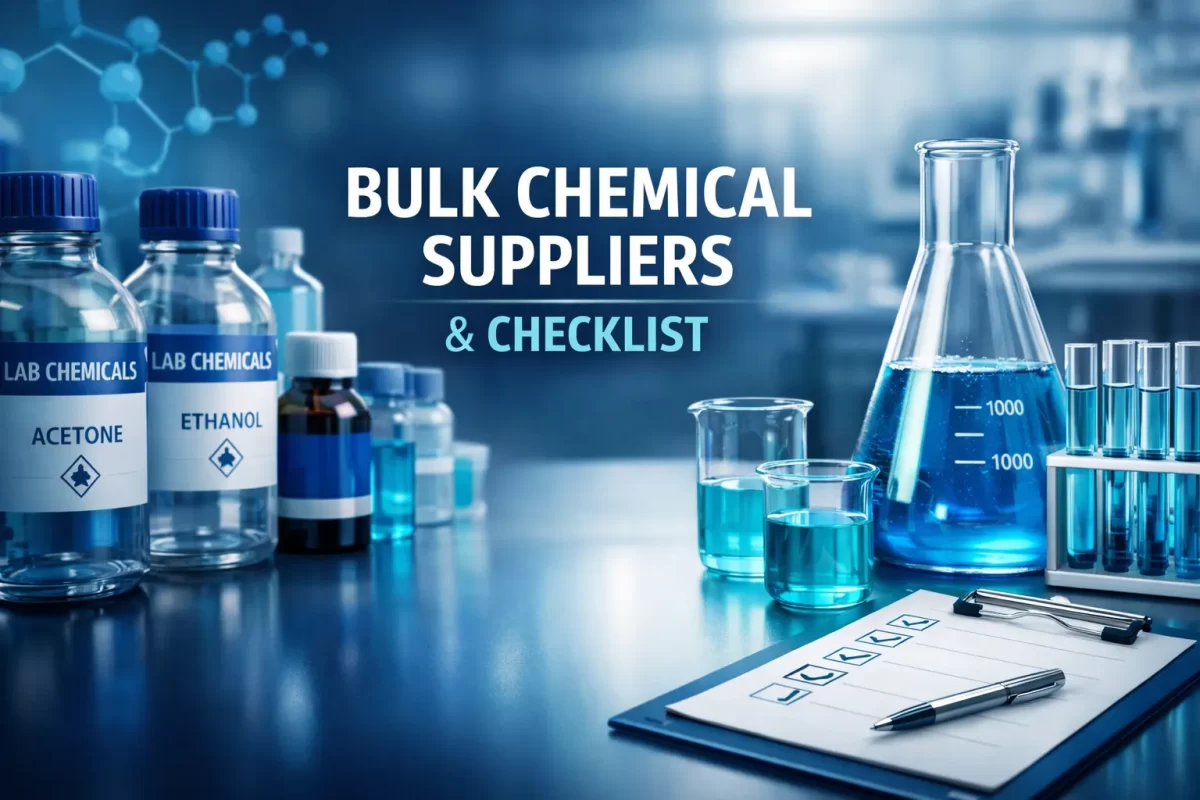
Wholesale Laboratory Chemicals: Bulk Suppliers & Checklist
Feb
Note: All products and procedures discussed here are intended for research and laboratory use only. RocazoneMix and the information in this guide are not for human consumption or medical use. Consult your institutional EHS for site-specific controls before purchasing or storing bulk hazardous materials.
Executive summary — when to buy bulk and how RocazoneMix helps you scale
Buy bulk when your lab or facility needs predictable supply, lower unit cost, and fewer interruptions to method development or production. Typical candidates: high-throughput analytical labs, CROs running repeated assays, process development groups scaling reagents, and institutional buying teams that can manage storage and compliance. Bulk purchases reduce the per‑unit price, improve lot consistency for reproducible data, and simplify procurement cycles — provided you manage landed cost, COA verification, and storage risk.
Prefer drums (55‑gal / 200‑L) or IBCs/totes when annual consumption exceeds single-drum volumes (for solvents this is often hundreds to thousands of liters per year). Keep bottles for sensitive reference standards and initial qualification lots where small-scale verification is faster and less risky.
How RocazoneMix fits this workflow: we supply laboratory-grade, batch-tested research chemicals (purity verified ≥98%), provide lot-specific COAs on request, and support institutional accounts with secure online ordering and discreet, compliant shipping. Use RocazoneMix as a compliance-first example while you shortlist other vetted distributors.
Immediate audit checklist (use now): request the lot-specific COA and SDS, ask the sales contact for packing sizes and hazmat shipping capability, and confirm with EHS whether your facility has compatible containment and storage capacity for the requested pack size.
The buyer’s decision framework — seven criteria to vet wholesale suppliers quickly
Evaluate suppliers against seven pragmatic criteria. For each criterion below I explain why it matters, how to verify it, an example question to ask, and a suggested pass/fail threshold you can apply during sourcing calls.
Documentation and transparency
Why it matters: A downloadable SDS and a lot-specific COA are the minimum documentary evidence you need to accept a bulk lot. Chromatograms and raw data reduce uncertainty for analytical standards.
How to verify: Check the public product page or request the documents before the order. Confirm COA includes lot number and analytical method. Ask for chromatograms for reference standards.
Ask: “Can you provide a downloadable SDS and the lot-specific COA (PDF) before shipment?”
Pass/fail: Pass if SDS is downloadable and the supplier commits to provide a lot-specific COA on request; fail if COAs are unavailable or only generic manufacturer specs are offered.
Verified quality
Why it matters: Batch-testing and third‑party certificates reduce the risk of off-spec material and failed experiments.
How to verify: Request the COA and ask whether the supplier performs in-house or third‑party testing and whether lot traceability is recorded. Cross-check claimed purity against the analytical method listed on the COA.
Ask: “Do you batch-test bulk lots and can you confirm lot traceability to raw material and QC results?”
Pass/fail: Pass if the supplier performs lot testing and records traceability; conditional if only supplier statements exist without data access.
Packaging and bulk sizes
Why it matters: The wrong pack size increases handling, storage risk, and costs. Drum deposits, IBC logistics and pallet rules matter to landed cost.
How to verify: Confirm available sizes (5 L, 25 L, 200 L, 275 L IBC, ISO‑tank) and which pack types (steel, HDPE) are offered for your chemical and packing group.
Ask: “What pack sizes and container materials do you supply for
Stimulants
Pass/fail: Pass if the supplier stocks the pack sizes you need; conditional if they can only arrange special packaging on request with long lead times.
Hazmat shipping competence
Why it matters: Incorrect documentation or packaging can lead to rejected shipments, fines, and safety incidents.
How to verify: Ask which modes the supplier uses, whether staff are trained for DOT/IATA/IMDG, and whether they prepare Shipper’s Declarations and bills of lading for hazardous goods.
Ask: “Can you ship this product by the mode we require and will you provide the shipper’s declaration and hazmat documentation?”
Pass/fail: Pass if the supplier confirms trained hazmat personnel and written procedures for the chosen mode; fail if they cannot document compliance.
Commercial terms
Why it matters: MOQs, tiered pricing, lead times and return policies materially affect project budgets and risk.
How to verify: Request MOQs, sample policy, typical lead time, payment options and returns/credit terms in writing.
Ask: “What is the MOQ, lead time, and your policy for nonconforming bulk lots?”
Pass/fail: Pass if MOQs and terms align with your timeframe and risk tolerance; conditional if terms are negotiable but not transparent; fail for unreasonably high MOQs or no remediation policy.
Customer support & logistics
Why it matters: Dedicated account management, samples for qualification, and expedited options reduce procurement friction and speed validation.
How to verify: Confirm existence of a dedicated account manager, sample policy, and whether they offer tracked shipments with temperature control if required.
Ask: “Do you assign a single point of contact for institutional accounts and do you offer sample drums for qualification?”
Pass/fail: Pass if you have a named contact and clear sample policy; conditional if contact is ad hoc.
Regulatory & export compliance
Why it matters: Import/export permits, TSCA or REACH considerations and export controls can delay or block international deliveries.
How to verify: Ask whether the supplier is familiar with TSCA/REACH reporting and whether they will provide export paperwork and regulatory declarations upon request.
Ask: “Can you support TSCA declaration/recording or provide REACH compliance documentation for EU shipments?”
Pass/fail: Pass if the supplier acknowledges regulatory obligations and will provide paperwork; fail if they cannot support regulatory export/import requirements.
Scoring suggestion: assign weights to criteria (documentation 25%, quality 20%, lead time 15%, price 15%, MOQ 10%, support 10%, compliance 5%). Score each supplier 0–5 per criterion, multiply by weight and rank. This quickly produces a shortlist of 2–3 vendors for RFQs.
Pricing reality and MOQs — how to compute landed cost and negotiate better terms
Bulk price is more than the catalogue unit price. Landed cost includes packaging, freight with hazmat surcharges, insurance, customs and local handling. Compute landed cost before comparing suppliers.
Core landed cost formula (per delivered liter/kg):
Landed unit cost = (product unit price) + (packaging deposit ÷ units per package) + (freight & hazmat surcharge ÷ units) + (insurance & handling ÷ units) + (customs/duties ÷ units) + (local delivery & storage ÷ units)
Worked example — converting price per kilogram to price per liter for isopropanol (IPA).
Formula: price_per_liter = price_per_kg × density (kg/L)
Assume a quoted price of US$1.30/kg for IPA and density 0.785 kg/L:
price_per_liter = 1.30 × 0.785 = US$1.02 per L (rounded)
Applied to a 200-L drum: mass = 200 L × 0.785 kg/L = 157 kg. Product cost = 157 kg × $1.30/kg = $204.10. Add packaging deposit (example $30/drum), freight/hazmat ($150), insurance ($20), customs/duties (~3% of product value ≈ $6.12), and local handling ($40). Total landed drum cost ≈ $450.22. Per liter landed cost ≈ $2.25/L.
Note: these numbers are illustrative. Use actual quotes for precise budgeting and confirm packaging deposits and surcharges with carriers. Solvent densities vary; verify the SDS physical data sheet for each product.
Indicative price ranges (labelled: subject to confirmation): isopropanol (IPA) export prices have recently shown ranges from approximately US$0.90–2.20/kg depending on volume and region. Ethanol and strong acids vary widely by market and purity; request quotes for current figures. Treat these ranges as market signals, not firm offers.
Negotiation tactics tailored to labs:
- Bundle purchases across SKUs to reach volume tiers and reduce freight per unit.
- Request price locks for 3–12 months on committed volumes to protect budgets during short market swings.
- Propose volume tiers with automatic rebates at thresholds (e.g., 5 drums → 3% rebate; pallet → 7%).
- Consider consignment inventory with a logistics partner if storage capacity limits exist; this reduces working capital but requires contractual control.
- Negotiate payment terms: ask for Net 30 with a reduced price, or prepay for a short-term discount if cashflow allows.
- Request a qualification sample drum or 5–25 L sample lot before committing to full drums or IBCs.
Practical procurement caveats: always request the COA before dispatch, insist on a documented return/remediation policy for off‑spec lots, and retain the sample used for incoming QC until the lot is released from quarantine.
Fifteen vetted wholesale suppliers — concise profiles and when to choose each
Below are 15 suppliers grouped roughly by specialization: high‑purity lab standards, industrial/bulk distributors, and hybrid/regional partners. Each profile explains the typical fit, packaging options, documentation practices and a starter question for sales.
RocazoneMix — Best for verified research-grade reagents and reference materials. Typical pack sizes range from small bottles up to drums and bulk orders arranged for institutional accounts. Documentation: lot-specific COAs are available on request and we batch-test to ensure purity ≥98% for listed compounds; SDS and CAS identifiers are provided. Geographic reach: worldwide, with secure online ordering and discreet, compliance-focused shipping. Ask: “Can you provide a lot-specific COA and confirm the shipping mode and packaging you recommend for [CAS] to my site?”
Calpac Lab — Best for laboratory-focused bulk solvents and specialty reagents. Offers 5–55 gallon pack options for common acids and solvents. Documentation: SDS available on product pages; commercial quotes often include additional technical data on request. Primarily U.S.-focused. Ask: “What bulk pack sizes do you hold in stock for and can you confirm stock availability and lead time?”
Spectrum Chemical — Best for a broad catalog spanning lab reagents to scale‑up intermediates. Offers scale-up quantities with cGMP-capable product lines for some SKUs. Documentation: SDS and COA access typically available to account customers; lot traceability for many laboratory products. U.S. distribution with global reach via reseller networks. Ask: “Do you provide lot traceability and can you supply bulk COAs for this SKU?”
Alliance Chemical — Best for diverse inventory and private-label/blending services. Stocks thousands of SKUs with 5 L to full-tote options and can support custom blends. Documentation: SDS and COA options and formal lot traceability are part of their service model. Nationwide U.S. warehousing. Ask: “Can you support custom packaging or private‑label lots for this reagent and provide COA traceability?”
Lab Alley — Best for wide availability of solvents and faster turnaround on common lab consumables. Offers 1–55 gallon drums and IBCs on common solvents and acids. Documentation: SDS available online; COA typically available by request for higher‑purity grades. U.S. reach and expedited shipping options. Ask: “Is a lot-specific COA available for your bulk 200 L drums of , and can you arrange autoship for re-ordering?”
General Laboratory Supply (GoGenLab) — Best for regional fulfillment and networked distributor access. Offers bulk ordering via ALADN network and can ship internationally from central U.S. hubs. Documentation: SDS on request; bulk COAs available backgrounded by distributor agreements. Ask: “Can you route bulk shipments internationally from your Houston hub and handle export paperwork?”
Thermo Fisher Scientific / Alfa Aesar — Best for high-purity analytical standards and research reagents with strong QA. Typical pack sizes range from small lab bottles to negotiated bulk containers for select products. Documentation: COAs and SDS widely available for traceable lots; quality systems underpin cGMP-capable production for some lines. Global reach and technical support. Ask: “Can you provide manufacturer COAs and support for lot qualification on this analytical standard?”
Avantor / VWR — Best for institutional procurement with integrated supply chain services. Offers bulk ordering and logistics for many lab reagents; pack sizes vary by SKU. Documentation: SDS widely available; COA access typically requires account credentials. Large global distribution footprint and contract purchasing options. Ask: “What are your standard contract terms for institutional bulk orders and how do you deliver COAs?”
Fisher Scientific — Best for consolidated purchasing and vendor-managed inventory programs. Extensive catalog and ability to source bulk pack sizes through partner channels. Documentation: SDS online, COA access via account or sales support. Global distribution and institutional contracting. Ask: “Do you offer vendor-managed inventory (VMI) or consignment programs for bulk solvents?”
Merck / Sigma-Aldrich — Best for highest-grade reference reagents and analytical standards. Primary focus is on quality and documentation for labs needing traceable standards. Bulk pack options are usually handled via sales with COAs and method details. Ask: “Can you provide the full COA and chromatogram for this lot and outline your retention and traceability policy?”
Brenntag — Best for industrial-scale supply and logistics for high-volume solvent and acid needs. Offers 55-gallon drums, IBCs and ISO-tank services; documentation varies by product but is available for commercial accounts. Ask: “Can you ship by ISO-tank for multi‑ton orders and supply regulatory paperwork for import/export?”
Univar Solutions — Best for industrial chemical logistics and multi-modal shipping for large volumes. Stocking typically includes commodity solvents and reagents with options for private-label or bulk supply. Documentation and COA availability are sales-dependent. Ask: “What are your MOQ tiers and can you provide COAs for production-grade lots?”
Grainger — Best for quick-access stocking and local distribution of bulk-compatible items through distributor partnerships. Useful for non‑critical bulk consumables where speed matters. Documentation: SDS available for most SKUs; COA availability depends on underlying supplier. Ask: “Which manufacturer supplies your bulk and can you provide the COA?”
Ibis Scientific — Best for smaller labs and fast North American shipping; useful when sample drums or smaller bulk sizes are required quickly. Documentation: SDS available online; bulk COAs may require a sales request. Ask: “Can you fulfil 55‑gal drums and provide lot COAs for this solvent?”
Lab Depot / ChemSavers — Best for economical bulk and commodity reagents with regional distribution. Offers drums and large jugs for routine cleaning solvents and industrial reagents; COA availability varies. Ask: “Can you confirm grade (ACS/USP/HPLC) for the drum‑sized material and send the COA?”
When to pick which type: choose specialty lab suppliers (Thermo Fisher, Sigma‑Aldrich, RocazoneMix) for analytical standards and reference materials where traceable COAs and strict QC matter. Choose industrial wholesalers (Brenntag, Univar) for high-volume commodity solvents when purity specifications are looser and price is primary. Use hybrid/regional players (Alliance, Spectrum, Lab Alley) when you need a balance of documentation, custom packaging, and reasonable lead times.
How to build a supplier comparison matrix and score candidates
A simple spreadsheet reduces subjectivity. Create columns for: supplier name, product/CAS, pack sizes available, quoted price per unit, estimated landed cost per unit, COA availability (Y/N), lead time, MOQ, payment terms, return policy, support contact, and notes. Rows are SKUs or supplier offers. Populate the matrix for at least three suppliers per critical SKU.
Weighting logic (example): documentation 25%, lead time 20%, price 20%, MOQ 15%, support 10%, compliance 10%. Convert qualitative answers to numeric scores (0–5) and multiply by weights to produce a weighted total. Higher total = higher priority for RFQ.
Worked example — HPLC-grade isopropanol in 200 L drums:
Fields to record: supplier A price per drum $450, provides COA on request (Y), lead time 7 days, MOQ 1 drum, payment Net 30, hazmat shipping verified. Supplier B price per drum $420 but COA delayed until shipment, lead time 14 days, MOQ pallet (4 drums), payment prepay. Score documentation (A=5,B=2), lead time (A=5,B=3), price (A=3,B=4), MOQ (A=5,B=2), support (A=4,B=3), compliance (A=5,B=3). Apply weights and ranks to produce shortlist — in many labs the supplier with slightly higher price but immediate COA and single‑drum MOQ is the pragmatic choice.
Template: use the supplier comparison template and the bulk pricing calculator to standardize quotes and easily compare landed costs across suppliers.
Verifying quality — how to read an SDS, interpret a COA and flag chromatograms
Quality verification is a small investment that avoids costly failures. Focus on the SDS, the COA and any chromatographic evidence supplied.
Reading the SDS – must-have sections
Section 1 (Identification): confirms product name, CAS and supplier contact details. Section 2 (Hazards): regulatory classification and primary hazards for handling. Section 9 (Physical and chemical properties): density, flash point, boiling point — essential for conversions and storage planning. Section 14 (Transport information): UN number, packing group and mode-specific restrictions for shipping. Verify that the SDS matches the COA product identity and declared concentration.
Interpreting the COA — required fields and red flags
Required COA fields: supplier name, product name and CAS, lot number, assay or purity (with units), analytical method used (e.g., GC-FID, HPLC-UV), acceptance specification, date of analysis, analyst or laboratory signature, and any reported impurities with quantitative values where relevant.
Red flags: COA missing the analytical method, absence of a lot number, no acceptance criteria, or a COA that only lists a generic vendor spec without lot traceability. If a COA lacks impurity profile for an analytical standard, treat it as incomplete.
Reading chromatograms
Chromatograms should show baseline stability, clearly resolved peaks for the analyte and any known impurities, and a retention time consistent with the method and laboratory instrument conditions. Ask for annotations: which peak is the analyte, internal standard retention time, and signal-to-noise or LOQ/LOD evidence. If a chromatogram shows unexpected peaks or poor peak shape, request raw data files (e.g., instrument export) and a method narrative.
Acceptance criteria — practical examples
Institutional practices vary. Typical guidance: for analytical reference standards demand assay within ±0.5% of the declared value; for high-purity solvent lots ±1% is often acceptable; for routine industrial reagents ±2% may be tolerated. Use contractually agreed thresholds: if a reference standard is >±0.5% off label, require re-analysis or replacement. For bulk solvents, if assay is outside agreed tolerance (e.g., >1–2%), invoke remediation or return clauses. Always define the acceptance band in the PO.
Chain-of-custody and sample retention
Request recorded lot traceability and a chain‑of‑custody form for large orders. Ask whether the supplier retains samples and for how long (common retention periods are 6–12 months). For critical purchases, require a documented sample retention policy and a commitment to provide raw data upon request. RocazoneMix provides lot-specific COAs on request and supports traceability documentation to help upload COAs to your LIMS.
Operational step: do not accept bulk shipments without first receiving the COA or an explicit written commitment and the sample required for in‑house verification.
Packaging, labeling and shipping compliance for bulk hazardous reagents
Mode-specific regulations differ: domestic highway and rail shipments in the U.S. are regulated under DOT 49 CFR; air shipments must follow IATA/ICAO Dangerous Goods Regulations; sea shipments use the IMDG Code. The choice of mode affects allowable quantities, packaging instructions and documentation.
| Common reagent | UN number | Hazard class | Packing group (typical) |
|---|---|---|---|
| Isopropanol (IPA) | UN1219 | 3 (flammable liquid) | II |
| Ethanol | UN1170 | 3 (flammable liquid) | II (concentration dependent) |
| Hydrochloric acid | UN1789 | 8 (corrosive) | II (concentration dependent) |
| Nitric acid | UN2031 | 8 (corrosive), subsidiary 5.1 (oxidizer) | II |
Packaging and UN compliance: choose UN-approved containers appropriate to packing group and mode. Common pack types include steel drums for many flammables, HDPE drums for corrosives compatible with the reagent, IBCs/totes for larger volumes and ISO‑tanks for intercontinental multi‑ton shipments. Confirm container compatibility with SDS Section 9 (density, corrosivity) and supplier guidance.
Required documentation for international bulk shipments typically includes:
- Commercial invoice and packing list
- SDS for the shipped lot
- Shipper’s Declaration for Dangerous Goods (air) or appropriate dangerous goods declaration (sea)
- Bill of lading / sea waybill or air waybill
- Customs paperwork and any export permits (TSCA, licences) where applicable
Operational tips: work with carriers experienced in hazardous chemical transport, confirm carrier acceptance for the product and packaging, insist on trained hazmat personnel for labeling and documentation, and test seals and labels immediately on receipt. Always consult institutional EHS before finalizing shipping mode; IATA and IMDG are updated annually — verify you have the current edition. For practical, plain-language guidance on ensuring chemical shipments comply with DOT/IATA/IMDG rules, see this industry guide: Ensure chemical shipments comply with DOT/ADR/IATA and IMDG regulations. Your institutional EHS may also publish transport-specific guidance such as the example provided by a university EHS office: Chemical transporting & shipping guidance (SMU).
Ordering workflow, contract terms and negotiation templates
Standard procurement workflow, condensed into actionable steps: RFQ → sample testing → purchase order → shipment and manifest → receipt and QC → invoice and payment. Document the RFQ response and supplier commitments at each step to reduce disputes.
RFQ checklist — fields to request in writing: product name and CAS, required grade and purity, requested packaging and quantity, required lot-specific COA and SDS, desired lead time, Incoterm and delivery location, payment terms, special handling instructions, and any regulatory import/export requirements.
Sample RFQ email (concise, vendor-ready):
Subject: RFQ — [Product name] (CAS xxxx‑xx‑x), [pack size], [required qty]
Message: Please provide a quote for
Stimulants
Sample PO clause to require lot-specific COA and remediation:
“Seller must furnish a lot-specific COA and SDS prior to shipment. Buyer reserves the right to reject any lot that does not meet the COA specifications. For any lot confirmed off-spec, Seller will, at Buyer’s option, (a) replace the lot at no charge, or (b) issue credit for the purchase price and reasonable inbound testing costs. Seller will reimburse Buyer’s third‑party analytical verification if the lot is off-spec.” (Customize with days for inspection and dispute resolution.)
Payment and contract levers: negotiate Net 30 or Net 45 payment terms against an established account to preserve cashflow. Offer minimum annual commitment in exchange for lower per-unit pricing or price protection clauses. Price escalation clauses tied to a published index can protect both parties. Insist on an insurance clause that requires carrier and seller liability up to agreed incoterm limits.
Returns and nonconformance: document acceptance testing windows (e.g., 30 days to perform QC) and hold shipment in quarantine until COA verification is complete. Establish escalation contacts and a clear RMA (return merchandise authorization) process for drums and IBCs.
Receiving, storage and operational compliance checklist for bulk deliveries
Receiving workflow (prose): verify pre-arrival paperwork (SDS, COA and shipping documents), confirm shipment matches PO and COA lot numbers before unloading, photograph labels and seals, and document any physical damage. Move the shipment to a quarantine area and collect samples for incoming QC; do not release to general inventory until QC passes.
Storage & lab controls: segregate incompatible classes (acids vs bases vs oxidizers), maintain compatible secondary containment, use ventilated storage for volatile solvents, and store flammables in certified flammable storage cabinets. Use temperature-controlled storage if required by the COA or SDS. Consult EHS for maximum permitted on-site quantities and local fire code requirements.
Inventory and recordkeeping: log lot number, COA, receipt date, storage location and expiry/shelf-life in your LIMS or inventory system. Attach a digital copy of the COA to the lot record and flag lots that require retesting before use.
Emergency readiness: maintain spill kits sized for drum/IBC incidents, ensure staff have quick access to SDS and emergency contact numbers, and run regular drills. Maintain neutralizers and absorbents appropriate to your stored chemistries.
Labeling and compliance: mark bulk containers with research‑only language where required and attach institutional disclaimers in purchasing documents. Maintain a visible segregation map and ensure all handling staff have current hazmat training certifications.
Action plan, templates, links and next steps — shortlist suppliers and request COAs (RocazoneMix CTA)
Execute this five-step action plan within 48–72 hours to move from evaluation to a controlled first order:
- Run the supplier comparison template for three candidate suppliers and compute weighted scores.
- Send the RFQ email template to the top three suppliers and request downloadable SDS and lot-specific COAs before shipping.
- Request a sample lot (5–25 L or a sample drum) for in-house QC and ask for the supplier’s sample retention and traceability policy.
- Confirm hazmat shipping capability, carrier acceptance and lead time for the selected pack size, and obtain a written shipping plan.
- Place a controlled first order (single drum or IBC) with quarantine-on-receipt and a documented acceptance test plan in place — when ready, use the secure portal to place your order.
Downloadable templates and appendices you should use:
- Supplier comparison spreadsheet
- RFQ email template
- Annotated COA example (PDF)
- Receiving checklist PDF
- Basic landed-cost calculator (Excel)
- Products catalog
Request a quote: if you’re ready to proceed, request a bulk quote or request a lot-specific COA from RocazoneMix. We provide batch-tested lab-grade reagents with lot traceability and institutional account support to help you qualify first lots and scale safely. (COAs and SDS are provided on request; contact our accounts team for institutional purchasing options.)
Final checklist — two key actions before you sign a PO:
1) Confirm receipt of the downloadable COA and SDS for the exact lot number you will receive; 2) verify with EHS that your facility has the containment and permitted quantity to accept the selected pack size.
Responsible procurement closes the loop between sourcing and safe operations. Use the templates linked above, document each decision, and keep COAs attached to lot entries in your LIMS for audit readiness. When in doubt, require a qualification lot and speak to your supplier’s technical team for clarifications.
Appendix — authority links and glossary
Regulatory resources (check for current editions):
- U.S. DOT (49 CFR) hazardous materials regulations
- IATA Dangerous Goods Regulations (air)
- IMDG Code (sea transport)
- U.S. EPA TSCA information
- ECHA REACH guidance (EU)
Product examples on our catalog: Ephedrine Powder, Roca Zone Mix and 3CMC, Roca Zone Mix.
Glossary (short):
COA — Certificate of Analysis; lot-specific analytical report. SDS — Safety Data Sheet; product hazards and handling instructions. CAS — Chemical Abstract Service registry number. UN number — four-digit identifier for dangerous goods in transport. IBC — Intermediate Bulk Container (tote).
Summary and next steps
Key points: verify documentation before you buy bulk, compute landed cost rather than comparing catalogue prices alone, and ensure your supplier can support hazmat shipment and lot traceability. Use a weighted supplier-scoring matrix to reduce subjectivity and require a sample qualification lot where quality is mission-critical.
Start by running the supplier comparison template, sending the RFQ to your top three candidates, and requesting the lot-specific COA for the lot you intend to buy. When you’re ready, request a bulk quote or request a lot-specific COA from RocazoneMix; our team will confirm documentation and packaging options to help you complete a safe, compliant bulk purchase.
Contact your institutional EHS for site‑specific storage and handling approvals before any bulk delivery. All materials discussed are for research and laboratory use only; RocazoneMix enforces a strict non-human‑use sales policy and supports customers in maintaining compliance.

