Research Chemicals
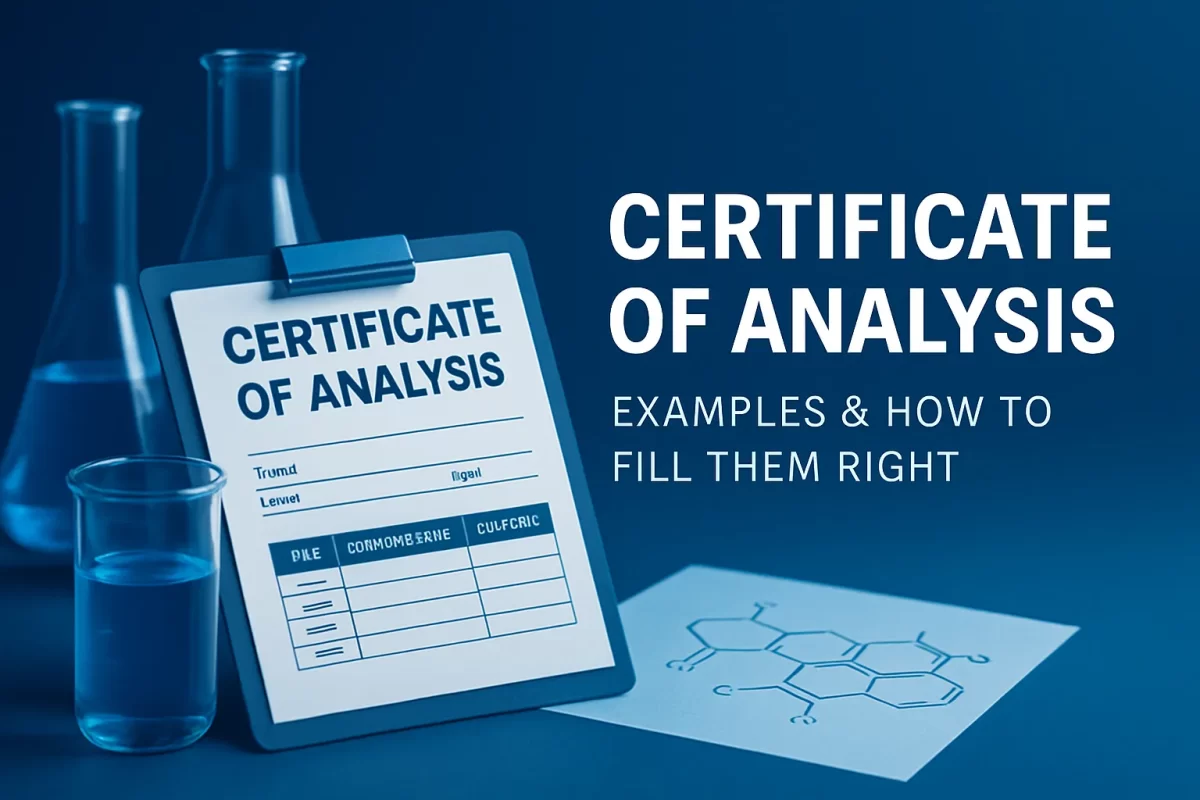
5 Certificate of Analysis Examples & How to Fill Them Right
Feb
Imagine you’re days away from a critical pharmacology study. Your lab racks are lined with vials of high-purity compounds, ready for analysis. But then, a simple clerical oversight: the expiry date is missing on your Certificate of Analysis. Suddenly, regulators raise flags, experiments halt, and weeks of work hangs in the balance. This isn’t just hypothetical—it almost happened at RocazoneMix. One of our senior researchers caught the error just in time while handling batches of 3CMC, Apaan Oil, and Etonitazene, thanks to a detailed COA template that flagged every missing field.
In this guide, you’ll learn how to build and fill a bulletproof certificate of analysis example that saves your lab from recalls, audit headaches, and wasted resources. We’ll unpack:
- The anatomy of a COA and why each element matters
- Five real-world COA templates—pharma, research chemicals, food, biotech CRO, and analytical standards
- A step-by-step workflow to complete your COA with zero errors
- Best practices and common pitfalls to avoid
- Free, editable downloads—including RocazoneMix’s custom template
Whether you lead an academic lab, work at a contract research organization, or manage QC for a biotech startup, mastering your COA is critical. Let’s dive in.
1. Why a Strong COA Matters
A robust certificate of analysis example is more than paperwork—it’s the backbone of trust, traceability, and compliance in any lab environment. Here’s how it pays off:
1.1 Building Trust & Ensuring Traceability
Your partners—suppliers, CROs, or academic collaborators—rely on COAs to confirm they’re working with the exact material specified. A COA that clearly presents CAS numbers, batch identifiers, and test results:
- Eliminates ambiguity: Precise details prevent mix-ups between similar compounds.
- Supports reproducibility: Teams can replicate protocols, reducing variability in multi-site studies.
- Secures data integrity: Digital signatures and version control provide audit trails for every change.
1.2 Meeting Compliance & Acing Audits
Whether you’re operating under FDA regulations for pharmaceutical APIs or ISO/IEC 17025 standards for analytical labs, your COA is the cornerstone of compliance:
- Audit readiness: Complete COAs demonstrate your quality management system is operational and standardized.
- Regulatory alignment: By referencing official test methods (USP, ICH, AOAC), you prove your data meets global criteria.
- Risk mitigation: Early detection of deviations prevents batch rejections, saving tens of thousands in rework costs.
For an in-depth look at what a certificate of analysis is, its key elements, and why they matter, check out this guide from Inbound Logistics. At RocazoneMix, every compound—tested to ≥98% purity—ships with a COA that meets or exceeds industry standards. You can order lab-grade research chemicals online with confidence, knowing quality is never an afterthought.
2. Anatomy of a Certificate of Analysis
A well-structured COA balances clarity with completeness. Below are the four core sections you’ll find in every robust certificate of analysis example. For further reading on the importance and key components of a COA, see the Contract Laboratory overview.
2.1 Product & Batch Information
This header section anchors your COA to a specific material:
- Product name: Include common name plus grade (e.g., “Benzyl Chloride, ACS Reagent”).
- CAS number & molecular formula: Ensures universal identification across systems.
- Batch/lot number: Unique identifier for traceability and recall scenarios.
- Manufacturing & expiry/retest dates: Use unambiguous formats like “Dec 1, 2025” to eliminate confusion.
- Sample receipt date: Records when the lab physically received material for testing.
2.2 Testing & Methods
Document every analytical procedure that underpins your results:
- Analytical methods: List SOP references for HPLC, GC, ICP-MS, Karl Fischer, microbial assays, etc.
- Environmental conditions: Note storage temperature, humidity, and container type during analysis.
- Acceptance criteria: Define spec limits (e.g., 98–102% assay, <500 ppm residual solvents).
- Method validation: Cite calibration dates and reference standards used for quantification.
2.3 Results Table
Clarity is king. Present your data in a concise, easy-to-scan table:
| Parameter | Test Method | Specification | Result | Unit | Status |
|---|---|---|---|---|---|
| Purity | HPLC (USP 2021) | 98.0–102.0% | 99.4% | % | Pass |
| Residual Solvent | GC (ICH Q3C) | <500 ppm | 42 ppm | ppm | Pass |
| Water Content | Karl Fischer | <0.5% | 0.35% | % | Pass |
| Microbial Count | USP 61 | <100 CFU/g | 12 CFU/g | CFU/g | Pass |
Visual guidance: Consistent column widths, subtle header shading, and standardized fonts help auditors and scientists find what they need instantly.
2.4 Certification & Disclaimers
Every COA concludes with sign-off details and legal statements:
- Analyst name & signature: Full name, employee or certification ID, and timestamped approval.
- Document version: Track revisions with version numbers and change logs.
- Use disclaimer: “For research use only. Not for human or animal consumption.”
- Liability statement: Clarify that results apply only to the tested batch under specified conditions.
3. 5 Real-World COA Templates
Below are five proven certificate of analysis example templates. Each addresses unique industry needs and offers pro tips for accurate completion.
Example 1: Pharmaceutical-Grade COA
Used for GMP-release of APIs and intermediates:
- Key fields: Potency assay, residual solvents, heavy metals, endotoxins, microbial contaminants, and expiry dating.
- Filling tips: Always report numeric values to two decimal places. Cite compendial references (e.g., United States Pharmacopeia).
- Documentation tip: Embed QR codes linking to the method validation report for rapid audit checks.
Example 2: Research Chemical COA (RocazoneMix Model)
Optimized for non-human use chemicals:
- Key fields: CAS numbers, batch traceability, reference standard comparisons, container type, and storage conditions.
- Pro tip: Automate data entry using LIMS integration—your COA populates itself as soon as assays complete.
- Why it works: We ensure every high-purity research chemical meets rigorous specs before it ships, supporting reproducible results across labs worldwide.
Example 3: Food & Nutraceutical COA
Designed for ingredients, supplements, and raw materials:
- Key fields: Nutritional profiles, allergen screening panels, microbial limits, heavy metal content.
- Formatting note: Distinguish between Certificate of Analysis (COA) and Certificate of Compliance (CoC) when labeling health claims. For a detailed comparison, see this COA vs. CoC breakdown.
- Use-case: Ideal for academic food science research and quality control in supplement manufacturing.
Example 4: Biotech CRO COA
For preclinical assays and bioactivity testing:
- Key fields: Bioactivity units, IC50/EC50 values, receptor binding curves, cell viability assays.
- Filling nuance: Link to sample prep and instrument calibration logs for end-to-end traceability.
- Audience: CROs conducting outsourced pharmacology, toxicology, and receptor-binding studies.
Example 5: Analytical Reference Standard COA
Benchmark materials for method validation:
- Key fields: Ultra-trace impurity limits, limit of detection (LOD)/limit of quantitation (LOQ), method validation summary.
- Best practice: Include a dedicated section citing validation protocols and calibration standard certificates.
- Ideal for: Analytical labs developing new assays or calibrating instruments to certified reference materials.
4. How to Fill Your COA: A 5-Step Workflow
Completing a certificate of analysis example accurately demands a repeatable process. Here’s a simple workflow to follow every time:
- Gather core data: Verify product details—name, CAS, batch/lot number, manufacturing date, expiry/retest date, and sample receipt date.
- Select validated methods: Reference each analytical procedure with SOP numbers or pharmacopeial citations (e.g., USP, ICH, AOAC).
- Enter results precisely: Populate the results table with numeric values, units, and compare against spec limits. Clearly mark pass/fail statuses.
- Add certifications: Include analyst signature, document version, and the mandatory “research-use-only” disclaimer.
- Review & archive: Perform a final QA check, lock the document, and store previous versions with date-stamped change logs.
Downloading our annotated form screenshots helps you visualize each field—grab them in the free template pack at the end of this guide.
5. Best Practices & Common Pitfalls
Even seasoned labs can fall prey to simple mistakes. Follow these guidelines to keep your COAs audit-ready and error-free:
- Use clear date formats: Spell out months (e.g., “Sep 15, 2025”) to prevent misinterpretation across regions.
- Provide numeric specificity: Avoid vague terms like “complies”—always report actual values (e.g., “pH 7.2”).
- List accreditation details: Include ISO/IEC 17025 or FDA registration numbers to build confidence.
- Maintain version control: Tie each revision to batch numbers and analysis dates for full traceability.
- Watch for missing fields: Confirm that spec limits, pass/fail columns, and signatures are never left blank.
- Update templates regularly: Regulatory guidelines evolve—review and refresh your COAs at least annually.
- Review an example of a bad COA to see common errors in action.
6. Free & Editable COA Templates
Ready to streamline your documentation? Download these professionally designed, editable templates and tailor them to your lab’s workflow:
- CocoDoc COA Templates – 22 free PDF templates with online editing and download.
- PDFSimpli COA Template – Editable PDF, no additional software required.
- PDFfiller COA Form – Interactive online form for quick data entry.
- ArtSyltech Digital COA Solutions – Automated digital COA generation and distribution.
- Bonus: RocazoneMix Custom COA Template – Excel & PDF versions pre-formatted for research chemical batches.
Customization tip: Add your company logo, adjust header colors, and enable dropdown fields for seamless data entry via your LIMS.
Conclusion
A clear, detailed certificate of analysis example does more than document test results—it safeguards your research, streamlines audits, and strengthens collaborations. By mastering the COA anatomy, experimenting with real-world templates, and following a disciplined fill-out workflow, your lab will avoid costly recalls and regulatory delays.
Next steps:
- Download the free templates above and customize them for your lab.
- Implement the five-step COA workflow in every batch release.
- Subscribe to RocazoneMix’s Compliance Toolkit for deeper insights, annotated visuals, and industry updates.
- Have questions? Contact our team for personalized support.
Disclaimer: All templates, procedures, and materials discussed are for research and laboratory use only. Not for human or animal consumption.

