Research Chemicals
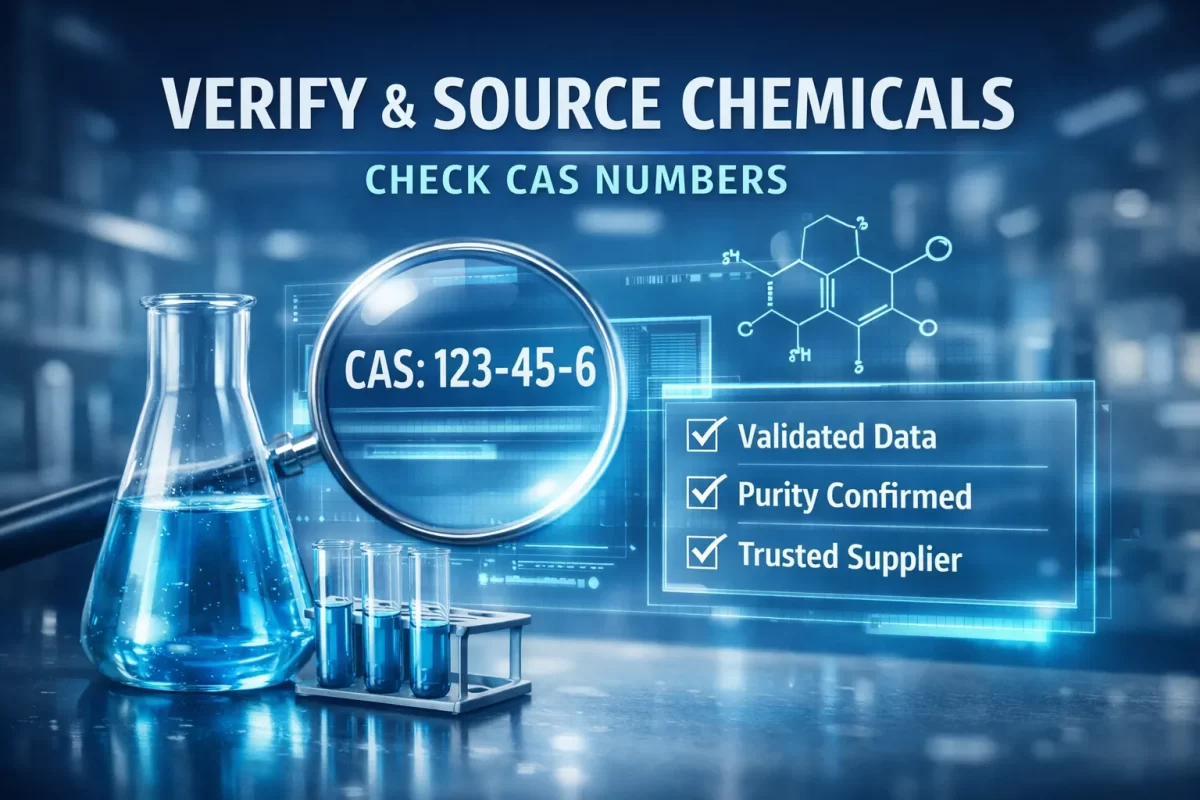
CAS Numbers Unlocked: Verify & Source Research Chemicals
Feb
Procurement errors—ordering the wrong salt, stereoisomer, or hydrate—waste time and break reproducibility. A correctly used CAS Registry Number (CAS RN) removes ambiguity and becomes your procurement blueprint. This guide gives a step‑by‑step workflow: how to look up a CAS RN, confirm structure identifiers (InChIKey/SMILES), locate suppliers that publish CAS numbers, and perform the essential documentation and regulatory checks before purchase. All compounds discussed are intended for research and laboratory use only; not for human or animal administration.
What a CAS Registry Number is—and what it does (and doesn’t)
The CAS Registry Number is a unique numeric label assigned sequentially by Chemical Abstracts Service to a distinct chemical entry in its registry. It is a database pointer, not a structural encoding. The format is three hyphen‑separated groups (up to 7 digits)-(2 digits)-(1 check digit), for example 7732-18-5 for water. The trailing check digit validates transcription and prevents simple errors.
Worked check‑digit example (concise): for 7732-18-5, remove hyphens and the check digit, reverse the remaining digits to 218377, multiply each by 1,2,3… (8×1 + 1×2 + 2×3 + 3×4 + 7×5 + 7×6 = 105), and 105 mod 10 = 5, which matches the check digit. If the result differs, the CAS RN is mistyped.
Limitations you must respect: one CAS RN denotes one registered registry entry but does not carry stereochemical, salt/hydrate, or formulation information. The same parent molecule may have multiple CAS RNs for different salts, solvates, or enantiomers; UVCBs (substances of unknown or variable composition) are separately registered. When sourcing, treat the CAS RN as a precise reference and verify the associated structure identifiers before ordering.
Practical CAS lookup: free tools, aggregators, and when to escalate
Use a tiered approach: start with public databases, move to aggregator catalogs, and use subscription registries for exhaustive or commercial indexing. Follow these concise steps when you have a CAS RN and need firm identifiers and supplier options:
- Search PubChem (free): paste the CAS RN into PubChem’s search bar, open the best match, and copy Canonical SMILES, InChIKey, and the CID from the “Names and Identifiers” or “Computed Descriptors” sections. Download SDF/CSV for LIMS records if needed.
- Check ChemSpider (free): enter the CAS RN (with or without hyphens) to reach the compound page, then review the “Suppliers” section for vendor links and cross‑references; use advanced search for exact matches if multiple records appear.
- Use CAS Common Chemistry vs SciFinder: Common Chemistry covers common substances with structures, names, and InChIKeys; SciFinder (subscription) accesses the full CAS REGISTRY and the CAS Commercial Sources index—use it when a compound or vendor is obscure or when you need curated commercial listings. For registry-level information see the CAS REGISTRY overview.
- Search aggregators/commercial catalogs: compare supplier stock and purity via platforms like eMolecules or SciFinder Commercial Sources; filter by CAS RN, purity, and lead time to shortlist vendors.
Troubleshooting: no match? Try alternate names and synonyms, search for the salt or hydrate form, or submit a CAS Registry lookup request for confirmation. Always keep the check‑digit validation in your quick QA routine.
Cross‑checking identity: match CAS to InChIKey, SMILES and structure
Verifying identity means moving beyond the CAS RN to confirm connectivity and stereochemistry. A practical verification sequence: retrieve the InChIKey and canonical SMILES from PubChem or CAS Common Chemistry; compare these identifiers byte‑for‑byte to those provided by the supplier or listed on their product page. If the supplier lists only a generic name or CAS without identifiers, request the lot‑specific InChIKey/SMILES.
An InChIKey mismatch typically indicates one of three things: a different stereoisomer, a different salt/solvate, or a transcription/labeling error. Visual differences—missing stereo wedges, different protonation states, or a counterion—are decisive. Use visualization and normalization tools (Open Babel or RDKit viewers for canonicalization, NIST WebBook for authoritative data) to render structures and confirm connectivity. Watch for tautomeric or protonation differences that change SMILES but not always InChI connectivity.
If identifiers disagree, pause the purchase: request the lot‑specific InChIKey/SMILES and raw spectral data (HPLC chromatogram, NMR summary) from the supplier and compare them to the public-record InChIKey or to a trusted standard. If the supplier cannot provide lot documentation, consider an alternative vendor or an independent analysis before large orders.
Verifying purity and documentation: what to ask for and how to read it
A trustworthy supplier provides lot‑specific documentation. A credible Certificate of Analysis (CoA) should contain the following core fields and evidence:
- Product and lot identification (product name, CAS RN, lot/batch number, quantity)
- Assay result with method (e.g., HPLC‑UV % area, GC % area, declared purity and acceptance limits)
- Analytical evidence (chromatograms, NMR summary or spectrum references, residual solvent analysis)
- Test methods and instrument conditions with dates and analyst signature
- Supplier/manufacturer identification and traceability statements
- Storage/expiration details and handling notes
Scan CoAs for red flags: generic PDFs without lot numbers, assays without method descriptions, or chromatograms that don’t match the reported retention times. Basic HPLC/GC interpretation requires confirming a dominant main peak (retention time consistent with a reference) and impurity peaks confined below stated limits; flat baseline and symmetric peaks suggest valid analysis. When in doubt, request raw spectral files and chromatogram metadata or commission third‑party testing.
At Rocazone Mix, Roca Zone Mix we provide batch‑tested CoAs on request and can supply chromatograms and technical support to help interpret results and integrate identifiers into your LIMS. Our products, Roca Zone Mix list CAS RNs on product pages and note validated ≥98% purity where applicable—supporting method development and streamlined procurement.
Finding reputable suppliers and a final compliance checklist
Vet suppliers by transparency and traceability rather than brand alone. Key checks to perform before ordering:
- CAS RN visibly listed on the product page and searchable sitewide
- Availability of lot‑specific CoAs and downloadable SDS files
- Evidence of batch testing, stated purity (e.g., ≥98% where applicable), and technical support contact
- Compliance signals: ISO/GMP statements, REACH registration or ECHA links where relevant
- Clear ordering, secure checkout, discreet/compliant shipping, and institutional invoicing options
- Return policy and procedures for non‑conforming material
Reliable commercial sources include large catalogs (MilliporeSigma/Sigma‑Aldrich, Spectrum Chemical, Pure‑Synth) and aggregator listings. Rocazone Mix, Roca Zone Mix positions itself as a transparency‑focused alternative offering searchable CAS identifiers, batch testing, technical assistance, and secure ordering for institutional accounts. See product pages such as PMK Powder Cas 28578-16-7, Roca Zone Mix and Etonitazene, Roca Zone Mix for examples of how CAS identifiers and CoA notes are displayed.
Before you submit a purchase, run a regulatory check using the CAS RN: query ECHA/REACH for EU obligations, search DEA or national controlled substance lists for scheduling, and confirm any export controls or dual‑use restrictions. If a CAS RN appears on a restricted list, obtain the necessary permits before ordering.
Next steps
Validate CAS and identifiers (InChIKey/SMILES) in PubChem or ChemSpider, request lot‑specific CoA and SDS, confirm regulatory clearance for your jurisdiction, then proceed to order. If you want documentation before purchase, request a lot‑specific CoA or browse our catalog of analytical reference materials. For verification assistance, contact our technical team at Contact, Roca Zone Mix.
You can also consult external resources for lookup and background: a concise overview of the identifier is available on Wikipedia: CAS Registry Number, and for practical PubChem guidance see this PubChem tutorial. For subscription‑grade indexing and vendor listings consider SciFinder and the source registry information at the CAS REGISTRY.
Summary: Treat the CAS RN as the procurement anchor—use public databases to extract InChIKey/SMILES, cross‑check structures visually, require lot‑specific CoAs, and confirm regulatory status. That sequence protects reproducibility and keeps procurement auditable and compliant.

