Research Chemicals
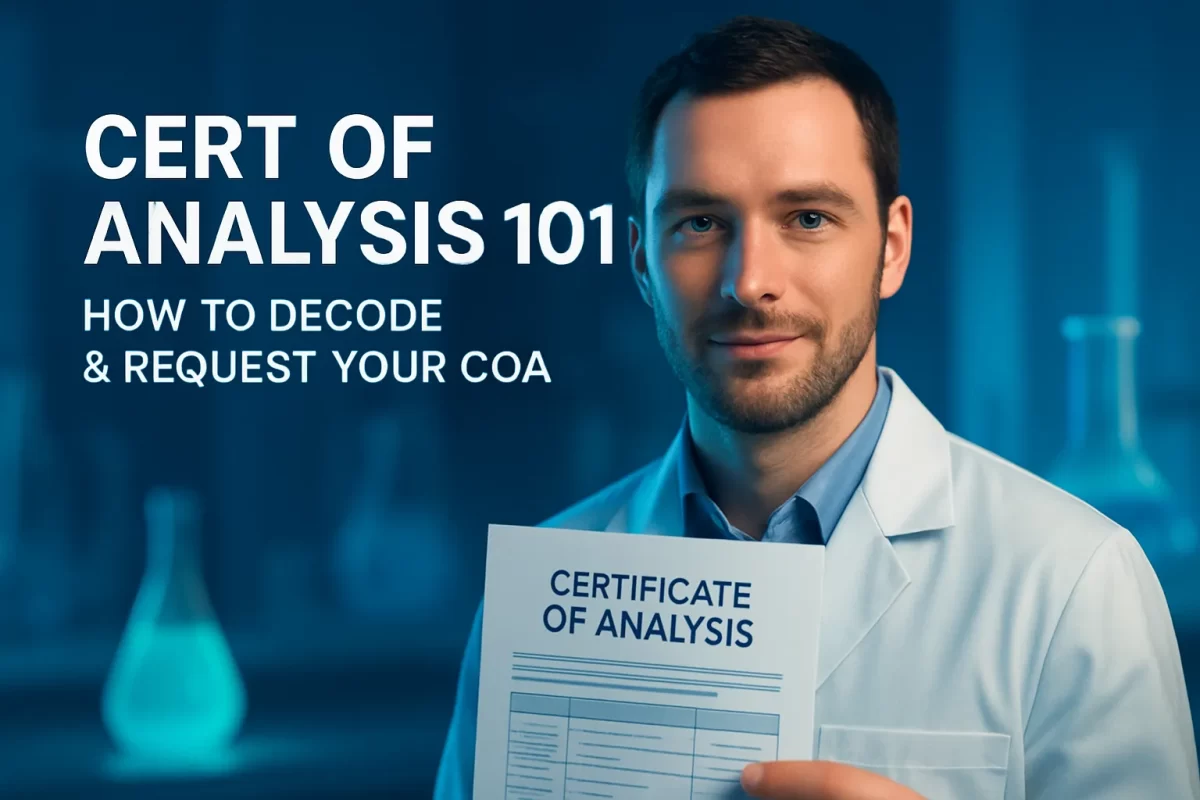
Cert of Analysis 101: How to Decode & Request Your COA
Feb
When I spent two days chasing down missing heavy-metal data for a sensitive assay, I realized how a sketchy Certificate of Analysis (COA) can derail any experiment. One mislabeled lot number and suddenly you’re scrubbing glassware, reordering materials, and burning precious lab hours. At RocazoneMix, we never want our customers stuck in that loop. Every high-purity batch ships with a full cert of analysis in under one hour—no guesswork.
In this guide, you’ll learn how to decode a COA line by line, compare industry formats, request or download your own, and stay audit-ready. By the end, you’ll handle COAs like a seasoned QC analyst—and ensure your research moves forward without a hitch.
What Is a Cert of Analysis?
A Certificate of Analysis (COA) is a formal lab document signed by an authorized analyst attesting that a specific lot or batch of material meets predefined criteria. It provides batch-specific proof of identity, purity, potency, and safety. Think of it as a passport for your sample: without it, traceability and compliance fall apart.
Typical COA contents include:
- Product & batch identification
- Issuer & accreditation details
- Sampling information
- Test methods & standards referenced
- Results, units, and measurement uncertainty
- Specification limits & pass/fail status
- Issue dates, version number, and signatures
- Remarks, disclaimers, and storage conditions
Why COAs Matter for Research & Industry
Ensuring Quality & Safety
A robust COA verifies assay, impurities, moisture content, and microbial limits before a batch ever leaves the dock. Industry surveys show that 30% of labs note significant discrepancies when relying on incomplete or outdated COAs—leading to wasted reagents, failed experiments, and safety risks. With a clear COA in hand, you can:
- Confirm active ingredient concentrations with confidence.
- Screen for heavy metals, residual solvents, and microbial contamination.
- Ensure batch-to-batch consistency in multi-step protocols.
Learn more about maintaining product quality in our partner article on Certificate of Analysis: Ensuring Product Quality and Compliance.
Regulatory Compliance & Traceability
Regulators demand proof. Whether you’re under FDA cGMP, EU GMP, or ISO 17025, COAs serve as your frontline defense. Lot numbers and batch records enable rapid recall in case of non-conformance. At RocazoneMix, we embed lot tracking at every step—so if a recall is ever needed, we can pinpoint and isolate affected materials in minutes, not days. Read about our full process in Quality Assurance in Research Chemical Manufacturing.
Building Trust & Streamlining Procurement
In vendor qualification, transparency speeds approvals. Our clients report a 25% faster QA sign-off when they receive a complete COA upfront. No back-and-forth clarifications. No unexpected lab hold-ups. You order, you receive, you test—confident that your reagent matches spec.
Anatomy of a COA: Section-by-Section Breakdown
Every COA follows a logical structure. Let’s dissect a typical report:
- Product & Batch Identification: Product name, catalog/SKU, lot number, manufacturing and retest dates.
- Issuer & Accreditation: Laboratory name, address, accreditation (e.g., ISO 17025), internal SOP references.
- Sampling Details: Sample size, collection date, collector ID—verifying representativeness.
- Test Methods & Standards: Pharmacopeial references like USP, ASTM, AOAC; analytical techniques such as ICP-MS or HPLC.
- Results & Units: Numeric values, number of replicates (n), uncertainty (±), and LOD/LOQ notes.
- Specifications & Pass/Fail: Acceptance criteria listed side-by-side with actual results.
- Version, Dates & Signatures: COA issue date, report number, QA sign-off from an authorized analyst.
- Remarks & Disclaimers: Storage conditions, scope limitations (e.g., “applies only to the tested batch”), and non-human-use statements.
Quick Tips: How to Read Your COA Like a Pro
- Match product ID + lot number to your packing slip—never assume.
- Verify method references align with recognized pharmacopeias (USP, AOAC, etc.).
- Compare results vs. specs—pay attention to “<LOQ” entries signaling trace-level detection.
- Check pass/fail statements and flag any out-of-spec (OOS) indicators.
- Confirm analyst signatures and test dates to ensure the COA is current.
For more on interpreting chemical reports, see How to Read a Chemical Certificate of Analysis (COA).
Bonus: Download your free COA Reading Checklist to simplify every review.
Industry Variations: COA vs. CoC & Sector-Specific Formats
Not all certificates are created equal. Here’s how they differ:
- Certificate of Analysis vs. Certificate of Conformity: A COA lists detailed batch test data; a CoC merely declares compliance without data.
- Pharmaceutical COAs: Conform to FDA cGMP and EU GMP Part II, with QA release signatures for APIs, excipients, and intermediates.
- Food & Beverage COAs: Include USDA allergen statements, microbial limits, moisture, and pH values.
- Industrial Chemical COAs: May reference ISO 9001 quality statements; focus on purity and performance specs.
- Cannabis & Botanical Extracts: Often cite AOAC methods and include pesticide and terpene screens.
At RocazoneMix, we tailor each COA template to your research field—so whether you’re developing a new drug or fine-tuning an assay, your certificate matches regulatory expectations.
How to Request or Download a COA: Step-by-Step
- Online Portal: Log in, enter the catalog number and lot, then download the PDF—instant access when you need it.
- Email Request: Send our QA team a simple template: “Product name, SKU, lot number, and purchase order.” Email QA@rocazonemix.com.
- ERP/LIMS Automation: If you integrate your LIMS with our API, batch QC events trigger automatic COA generation—no manual steps.
- Third-Party Labs: For specialized analyses, you can engage accredited external labs. We’ll coordinate sample transfers and deliver the signed COA when testing is complete.
- Troubleshooting: Missing COA? Escalate to your dedicated sales rep or contact our 24/7 support desk. We aim for zero delays.
Regulatory & Compliance Deep Dive
COAs live at the intersection of science and regulation. Key standards include:
- FDA cGMP and EU GMP guides for drug substances and intermediates.
- ISO 17025 requirements for test report elements—unique IDs, lab address, method references, measurement uncertainty, and statements of conformity.
- IPEC CoA Guide for excipients, emphasizing raw data traceability.
Modern labs leverage LIMS for automated audit trails, version control, and electronic signatures. At RocazoneMix, our multi-layer QA includes:
- In-house batch testing with validated SOPs.
- Third-party audits by accredited bodies.
- Discrete shipping and secure packaging to maintain sample integrity.
All RocazoneMix products are for research use only and not for human consumption or medical applications.
Summary & Next Steps
- What is a COA: A batch-specific proof of identity, purity, potency, and safety.
- Why it matters: Ensures quality, regulatory compliance, and streamlined procurement.
- How to read it: Match IDs, verify methods, compare specs, and confirm sign-off.
- How to get one: Use our portal, email QA@rocazonemix.com, or integrate via LIMS.
Integrate COA review into your SOPs today—download our COA Reading Checklist and template to get started.
Ready to Skip COA Headaches?
At RocazoneMix, every order of lab-grade chemicals comes with a certified COA—fast, compliant, and batch-tested. Explore our Lab-Grade Research Chemicals or Order High-Purity Standards now.
Order Now & Get Your COA Instantly
RocazoneMix products are strictly for research use and not for human consumption or medical applications.

